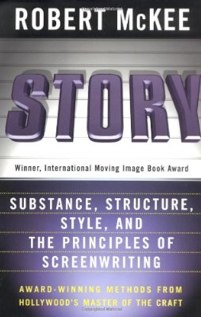
Robert McKee’s Story: Substance, Structure, Style, and The Principles of Screenwriting is a fantastically written exploration of dramatic writing. I particularly enjoy his advice that all protagonists must be empathetic, if not necessarily sympathetic. He illustrates by examining Macbeth:
Macbeth, for example, viewed objectively is monstrous. He butchers a kindly old King while the man is sleeping, a King who had never done Macbeth any harm—in fact, that very day he’d given Macbeth a royal promotion. Macbeth then murders two servants of the King to blame the deed on them. He kills his best friend. Finally he orders the assassination of the wife and infant children of his enemy. He’s a ruthless killer; yet in Shakespeare’s hands he becomes a tragic, empathetic hero.
The Bard accomplished this feat by giving Macbeth a conscience. As he wanders in soliloquy, wondering, agonizing, “Why am I doing this? What kind of man am I?” the audience listens and thinks, “What kind? Guilt-ridden … just like me. I feel bad when I’m thinking about doing bad things. I feel awful when I do them and afterward there’s no end to the guilt. Macbeth is a human being; he has a conscience just like mine.” […] Macbeth is a breathtaking display of the godlike power of the writer to find an empathetic center in an otherwise contemptible character.
Game publisher Electronic Arts was voted Consumerist’s annual Worst Company in America this year, beating out rival game company Activision and even Bank of America. Consumerist’s analysis of why this happened reveals that gamers are fed up with the publishing and pricing models of game content. Chris Kohler for Wired elaborates:
So it comes down as it often does to the almighty dollar: Consumerist readers, enough of them to massively swing the vote towards EA, think that videogames cost too much money.
“There have even been numerous accusations that EA and its ilk deliberately hold back game content with the sole intent of charging a fee for it at a later date,” Consumerist continued in its awards announcement.
Of late, it’s publisher Capcom that has come under fire over this: Owners of the new fighting game Street Fighter vs. Tekken have found that there are 12 characters already included on the disc that Capcom says it will sell access to at a later date.
To make ends meet, Capcom needs players to pay more than $60 for its games. That much is clear. But a $90 price tag at GameStop would be unthinkable. So it sells the game for $60, then asks gamers to pay more to unlock more content.
This is a warning to publishers of digital content of many kinds: an increase in technology costs will not automatically excuse price raises in the eyes of the consumer. Consumers have accepted that content is valuable, and they have formed expectations of how much content is worth. Games need to find a way to lower costs rather than increasing prices.
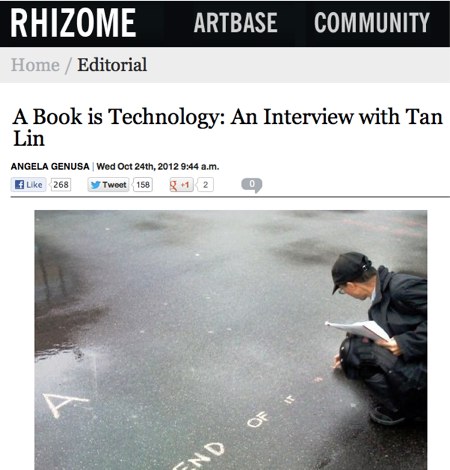
Tan Lin is a poet, artist, and filmmaker whose work challenges the idea of what constitutes a “book”, and what it means to have “read” something. Many of his works, particularlyHEATH (plagiarism/outsource) and Seven Controlled Vocabularies and Obituary 2004. The Joy of Cooking, involve multiple platforms including social media, RSS feeds, email, post-it notes, and programming languages.
In a recent interview, Lin takes a Cagean approach to reading, radically departing from the notion of the book as a codex or even self-contained object.
What led you to use so many different forms of technology in the creation and publication of a book? How would you define a book?
People forget that a book or codex is a technology. My interest with HEATH and 7CV was to treat the book as a distinct medial platform through which a lot of ancillary information passes, much like a broadcast medium like TV or a narrow-cast medium like Twitter or Tumblr. Reading is information control, just as a metadata tag is a bibliographic control. So I wanted to highlight the book’s medial and time-based underpinnings.
It’s interesting to see authors challenging the notion of the book, but by the end of the interview, it became clear that Lin was radically confronting the nature of what reading means. Lin argues that reading is an experience that cannot be extracted from extraneous subconscious perceptions (smell, location, etc.) and indirectly compares it to a Zen mood state.
But a Zen meditative state isn’t reading is it?
My print-based and web-based works both tend to operate with the minimum amount of material necessary needed to constitute what we call reading. I’m interested in the forms of non-reading and boredom, which surrounds all reading and aesthetic experience as its customary default. I mean I like it when works are boring. When I go to see a Cage performance or a Merce Cunningham dance, I am bored half the time. There’s nothing wrong with that. 7CV is about skimming material, appropriating other titles (like The Joy of Cooking) and indexes, and extending the book by enlisting 30+ grad students at The University of Pennsylvania to spin off what publishers would call ancillary titles. Can 7CV be made more interesting by individual readers? Absolutely. This is common in academia, a profession defined by writing books about other books, i.e., generating secondary source material. But there’s no reason secondary source material cannot be more interesting than original source material. Do you have to read 7CV to have read it? Not at all. Moreover, there are many ways to not read a book: you can leaf through it, read reviews or synopses of it, or just lie and say you read it when you didn’t. I was at Columbia where I got a Ph.D. in literature, and there were about 250 books on my orals reading lists—books I had to be able to talk about—but I probably only read a third of them. In fact, though, I had read all of them, just in different ways.
I’m not sure I’m convinced by his definition of reading, but the questions he raises are important, and these are things we need to discuss.
Sometimes actually explaining what our field actually is to the uninitiated is difficult. This 90 second talk by Mark Marino is essentially an ad for electronic literature.
A classic video of Bush’s Memex by Paul Kahn and Krzysztof Lenk of Dynamic Diagrams is available on YouTube. The animation was originally distributed at the ACM SIGIR conference in 1995, and is a great interpretation of the diagrams in “As We May Think.”
Hypertext pioneer Ted Nelson will be teaching a final “bucket” course this winter at UC Santa Cruz that will encompass all of his work on computer technologies and his ideas for future improvements. The course, “CINEMA OF THE MIND: Philosophy and Art of Designing Interaction” promises to be fantastic. HTLit will be sitting in on the class and will report back with details.
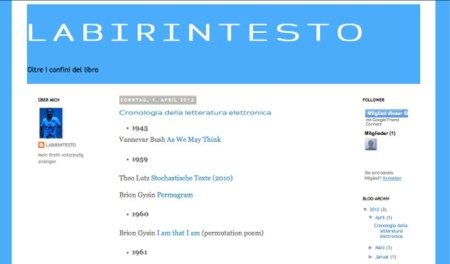
Labrintesto offers a Chronology of Electronic Literature that begins with Bush’s As We May Think. There are some strange omissions (no Ted Nelson until 2007?), but it’s a great starting point and a helpful resource.
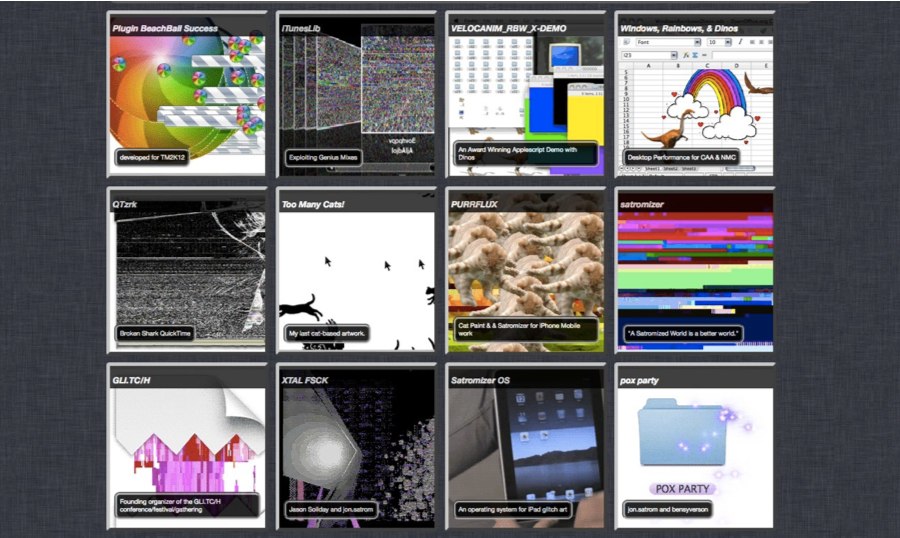
Jon Satrom performs interesting glitch pieces. His portfolio consists of videos of his performances, full of color, chaos, and cats. There may be the JODI-esque tendency toward boundary exploration, but with pieces about rainbows and dinos, nobody is taking himself too seriously.
Satrom’s portfolio is fun, but more importantly it presents an interesting perspective of glitch art: its performative quality. I’ve been deeply interested in the aesthetics of glitch work recently, specifically the idea that depending on the glitch process, the “art” might lie in the process—what was removed or changed—in the finished product, in the code, or any combination thereof. How, then, do we showcase the interesting parts?
Satrom does live performances, and his videos certainly capture that performative quality. We see the code. But we also see flashing colors, spinning beachballs, and ghostly almost-there moving images. The art is in how it all comes together.
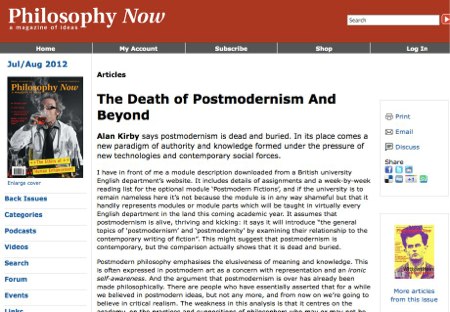
Alan Kirby declares once and for all that “Postmodernism is Dead.” Philosophers and popular culture—everyone, it seems, but English professors—have moved on. The postmodern canon is all decades old; it's time for academia to stop calling postmodernism "contemporary."
Most of the undergraduates who will take ‘Postmodern Fictions’ this year will have been born in 1985 or after, and all but one of the module’s primary texts were written before their lifetime. Far from being ‘contemporary’, these texts were published in another world, before the students were born: The French Lieutenant’s Woman, Nights at the Circus, If on a Winter’s Night a Traveller, Do Androids Dream of Electric Sheep? (and Blade Runner), White Noise: this is Mum and Dad’s culture.
So if contemporary works aren’t postmodern, what are they? Some would argue for the New Aesthetic, and while Kirby doesn’t cite James Bridle, his assessment places heavy emphasis on interactivity, participatory culture, ephemerality of the material text—ideas which complement the New Aesthetic’s fetishization of digital influence (even in analog arts and technologies). Kirby uses the (intentionally?) problematic term “pseudo-modernism” to refer to the products of today’s culture.
A pseudo-modern text lasts an exceptionally brief time. Unlike, say, Fawlty Towers, reality TV programmes cannot be repeated in their original form, since the phone-ins cannot be reproduced, and without the possibility of phoning-in they become a different and far less attractive entity […] Radio phone-ins, computer games – their shelf-life is short, they are very soon obsolete. A culture based on these things can have no memory – certainly not the burdensome sense of a preceding cultural inheritance which informed modernism and postmodernism. Non-reproducible and evanescent, pseudo-modernism is thus also amnesiac: these are cultural actions in the present moment with no sense of either past or future.
What Kirby calls “banal” and indicative of “puerile primitivism” are merely the products of an oral culture. He further complicates his arguments by comparing only trite instances of today’s popular culture with postmodernism’s highest art objects. It might be more fair to compare the postmodern authors with serious hypertext authors, or to compare postmodern film with the more serious video games. Comparing Francis Ford Coppola to “Call of War 17: Heroes of Killing Stuff” for XBox is unfair, especially when Journey or even Bioshock are sitting above it on the bestseller list.
The agency and control that computers have afforded us have undoubtedly changed our approach to all other media. Moreover, our awareness of this fact has in turn changed our relationship to the digital. However, that doesn’t mean that these new forms can’t produce permanent cultural artifacts, or that we will have no memory of our participatory experiences. My cartridge of Super Mario Bros is easily as permanent as my VHS copy of Clockwork Orange, and surely Shigeru Miyamoto gets as much credit for authorship as Kubrick does, even if the game is more participatory.
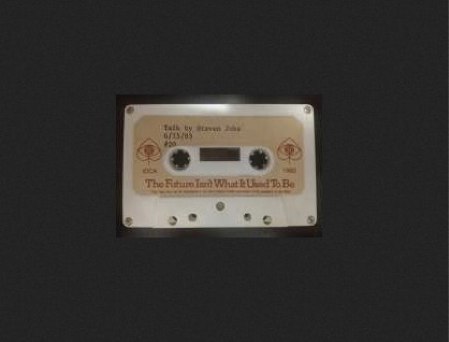
The folks at the Internet Archive recently added an obscure 1983 talk by Steven Jobs. Jobs was speaking to a group of designers, most of whom didn’t own personal computers. He mentions this new thing called electronic mail that he’s sure will change the way we communicate. It’s pretty remarkable how much he got right:
Jobs predicted we’d be spending more time with computers than cars in a few years.
He notes that it doesn’t cost extra to make the computer object attractive, and that the computers of the day “look like shit.” Jobs believes that computers should look nice, since they will soon be sitting in our work, education, and home environments.
He talks about email reshaping communication, and envisions “portable computers” that use radio waves to connect wirelessly to networks and will allow you to check your email while walking around.
He talks about networking and infrastructure, adding that we’re 5 years away from “solving” the problem of networking in business contexts and 10-15 years from networking being common in households.
He envisions a business model of software “sampling” before consumers buy. He also talks about the fact that software is digital, and therefore having physical distribution is unnecessary.
Mentions an MIT project that, in essence, is what we know as Google Maps street view.
The talk is filled with great quotes, but my favorite came during the Q&A session and seemed to capture the essence of the computing industry at the time:
“We’re solving the problem of putting some liberal arts into these machines.”
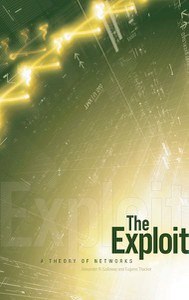
I recently read Galloway and Thacker’s chapter on “Nodes” from The Exploit: A Theory of Networks on the systems of power and control within network structures. Borrowing terms from graph theory, “nodes” correspond to what we would call lexia, “edges” connect the nodes, and networks can be described in terms of their “order” or how many nodes they contain, or their “size” which relates to their edges. Networks can also be described in terms of their connectivity (the interconnectedness of the nodes) and their topology (how centralized or decentralized the structure is based on which nodes are linked to which).
A huge portion of the essay is spent on the idea of “protocol” in both the familiar, computer science sense, but more importantly as a broader concept that encompasses that understanding—the protocol is the set of rules and standards that governs the network. The protocol exists in a tension between functioning as an emergent governing force, and one that can be externally imposed by, say, a system administrator or by the design of the network itself.
Galloway and Thacker have an interesting idea of control—influenced by Delueze—through modulation. They argue that in node structures, control is no longer dictated from a central figure (and even the protocol control structure is not an all-encompassing power), but rather “emerge through the complex relationships between autonomous, interconnected agents.(29)”
Within the hypertext literary community, there has been much debate over the idea of “authorship” within interactive work, the argument being that when you give the reader agency to maneuver within the story, she becomes a co-author of the work. This argument has met resistance from authors who insist that in building the framework of the piece, they are in fact, allowing the reader only the impression of agency, and thus maintain full authorial control. Viewing hypertext literature as a series of nodes , and the author’s embedded link structure as the piece’s protocol, it becomes easy to see how “control is not simply manipulation, but rather modulation” (33). The author may not be forcing the reader into a specific choice (manipulation), but she is directing the reader through a series of diegetic choices and constraints (modulation).
I was recently lucky enough to see a talk by Paolo Pedercini of Molleindustria (creators of previously-reviewed Phone Story and Every Day the Same Dream) on his own fascinating approach to politics and narrative in games. Pedercini seeks to engage the “bored employee network”—the demographic that plays Farmville between morning meetings—but takes a more aggressive, deconstructivist approach to casual games than mainstream game companies. He believes that the artifacts and memes that shape our culture can and should be smarter intellectual endeavors than glorified Skinner boxes or funny cats.
This approach is echoed in all of his works. Games like Phone Story, McDonald’sVideogame ,or Oiligarchy recall casual games through their visual aesthetics and their mechanics. McDonald’s Videogame plays like any resource management game of its kind. But where games like Diner Dash and Farmville present shallow choices whose only consequence is the outcome of the game, Pedercini’s games introduces a difficult moral dynamic, forcing the player to make unethical decisions to get ahead. He notes that “the freemarket system doesn’t punish you for being unethical” and he does an excellent job of presenting these systems in game form.
Much of Pedercini’s work, in fact, focuses on modeling real-world systems through game systems that showcase the social or political problems with their real-world counterparts. He talks about game creation in terms of recognizing a narrative or process that is “gameable,” meaning it will lend itself easily to gameworld constraints. The power of these games comes from the player’s participation in the system, and the emotion such systems are able to conjure. For example, Every Day the Same Dream’s game system models the repetitive endeavor of living the same day over and over through a monotonous office job. The player becomes bored and seeks out small changes that make her appreciate any variation in activities.
Most impressive, for me, is how much meaning and emotion can be packed into modeling certain real-world systems. Orgasm Simulator, for example, features a first-person view from a woman while she’s having intercourse with a man. The goal of the game is to successfully fake an orgasm to make your oblivious sexual partner “feel more like a man.” The implications for power, agency, and control are multiple and interesting, despite the game’s mechanical and graphic simplicity.
“With digital now converging with print and consumer behaviors changing, wanting immediate acces, portability, convenience, low prices. investments are changing […] and they’re changing radically. Publishers have to change with it because if they start getting displaced in how they present data, how they provide access to data—and it’s not just books, it’s data, it’s rich media data beyond the storytelling—[…] all of this will require investments and a different type of strategy.”
Sure, he’s mostly talking about books and doesn’t talk very much about the kinds of “rich media” he means, or ways that the media might enrich the story world, but it still suggests that the publishing industry is becoming aware that stories might extend beyond the page and across platforms.
Christine Wilks’s Out of Touch is an exploration into loneliness and the fetish (and artifice) of human connectedness inherent in social media, a theme to which many of us can relate.
by Mark Wernham. Machine #69 recalls Ryman’s 253, and especially Bob Arellano’s Sunshine ’69 both in its embrace of arbitrary connection and its fond nostalgia for the era when cheap booze, good drugs, fast cars and hot guns seemed to offer everything worth wanting and when nothing was worth wanting very much.
A new hyperromance for the Web. Sparsely linked, La Farge’s new hypertext nods at Stephanie Strickland’s design and to Michael Joyce’s direct address to the reader. but brings a new voice and sensibility to Web fiction.
Multimedia notes from underground, where a traumatized girl furnishes a cozy space in an underground tunnel. Script by Lynda Williams, music and code by Andy Campbell and Matthew Wright. A web work that’s especially nice on the iPad. (The floor lamp is a nice allusion. Get it?)




 Subscribe